


Industrial Abrasives Glossary
Industrial abrasives use a wide range of technical terms related to abrasive grains, bonding systems, wheel construction, dimensions, speed ratings, applications, and safety.
This industrial abrasives glossary explains common terms used with cutting discs, grinding discs, bonded abrasive wheels, and metalworking applications.
It is designed as a practical reference for distributors, wholesalers, purchasing teams, metal fabricators, and users who need to understand abrasive wheel specifications and choose the right product for a job.
Quick Guide to Industrial Abrasive Terminology
Most abrasive wheel terminology can be divided into several groups:
| Category | Common Terms |
|---|---|
| Abrasive materials | Abrasive grain, aluminum oxide, silicon carbide, zirconia alumina |
| Wheel construction | Resin bond, fiberglass reinforcement, bond hardness |
| Wheel types | Cutting disc, grinding disc, cut-off wheel, T27, T41 |
| Dimensions | Diameter, thickness, bore size |
| Speed ratings | RPM, maximum RPM, peripheral speed, maximum operating speed |
| Applications | Stock removal, weld grinding, deburring, beveling, surface preparation |
| Performance | Wheel life, sharpness, grinding efficiency, heat generation |
| Purchasing | OEM, private label, batch consistency, abrasive formulation |
Understanding these terms makes it easier to compare abrasive products and interpret the information printed on a cutting or grinding disc.
Abrasive
An abrasive is a hard material used to remove, cut, grind, shape, or finish another material through friction.
Industrial abrasives are commonly used for metal fabrication, welding, construction, automotive repair, machinery manufacturing, and other material-processing applications.
Abrasives may be used as loose grains, coated abrasives, or bonded products such as cutting and grinding wheels.
Abrasive Grain
Abrasive grain is the hard cutting material inside an abrasive wheel.
As the wheel rotates against the workpiece, exposed abrasive grains remove small amounts of material from the surface.
Common abrasive grains include:
- Aluminum oxide
- Silicon carbide
- Zirconia alumina
- Ceramic alumina
The abrasive grain type is one of several factors that influence cutting speed, grinding performance, wheel life, and heat generation.
Abrasive Formulation
An abrasive formulation is the combination of materials used to manufacture an abrasive wheel.
Depending on the product, a formulation may include:
- Abrasive grains
- Resin bonding materials
- Fillers
- Reinforcement materials
- Processing additives
Two grinding discs with the same dimensions can perform differently because their formulations are different.
For this reason, disc size alone does not determine grinding performance.
Aluminum Oxide
Aluminum oxide is one of the most widely used abrasive materials for grinding and cutting ferrous metals.
It is commonly found in abrasive products designed for:
- Carbon steel
- Mild steel
- Structural steel
- General metal fabrication
Different grades and formulations of aluminum oxide can be used depending on the required balance between cutting action, durability, and wheel life.
Arbor
The arbor is the spindle or shaft of the power tool on which an abrasive wheel is mounted.
The arbor dimensions must be compatible with the center hole of the disc.
Arbor Hole
The arbor hole, also called the bore or bore hole, is the center opening of an abrasive wheel.
For example:
180 × 6 × 22.23 mm
means:
- 180 mm diameter
- 6 mm thickness
- 22.23 mm bore size
The bore must match the mounting system of the intended machine.
Batch Consistency
Batch consistency describes how consistently abrasive products perform between different manufacturing batches.
For distributors and industrial buyers, consistency can be important because customers generally expect similar:
- Cutting behavior
- Grinding speed
- Wheel life
- Balance
- Dimensions
- Safety characteristics
Stable raw materials, production control, curing processes, and quality inspection all contribute to manufacturing consistency.
Beveling
Beveling is the process of grinding an angled edge onto a metal workpiece.
It is commonly performed before welding to create the required joint preparation or after fabrication to modify an edge.
Grinding discs are frequently used for heavier beveling applications because they are designed for material removal.
Bond
The bond is the material that holds abrasive grains together inside a bonded abrasive wheel.
The bond must retain the abrasive grains while allowing the wheel to wear in a controlled way during use.
Different bonding systems are used for different abrasive products.
Bond Hardness
Bond hardness, sometimes referred to as wheel grade, describes how strongly the wheel holds its abrasive grains.
It does not simply describe how hard the abrasive grain itself is.
A wheel that retains its grains longer behaves differently from one that releases worn grains more easily.
Bond characteristics influence:
- Cutting action
- Wheel wear
- Material removal
- Heat generation
- Overall wheel life
Bonded Abrasive
A bonded abrasive is a product in which abrasive grains are held together by a bonding material and formed into a defined shape.
Examples include:
- Cutting wheels
- Grinding wheels
- Depressed-center grinding wheels
Resin-bonded cutting and grinding discs are widely used in metal fabrication.
Bore Size
Bore size is the diameter of the center hole used to mount the abrasive wheel.
It is one of the three principal dimensions normally used to describe a disc:
Diameter × Thickness × Bore
Example:
125 × 6 × 22.23 mm
Ceramic Alumina
Ceramic alumina is a high-performance abrasive grain designed to maintain an effective cutting action under demanding grinding conditions.
It is often used where high material removal rates and sustained grinding performance are required.
Its suitability depends on the wheel formulation and the material being processed.
Cutting Disc
A cutting disc is a thin bonded abrasive wheel designed primarily to cut through material using the edge of the wheel.
Typical applications include cutting:
- Steel bar
- Metal tube
- Sheet metal
- Structural sections
- Metal profiles
Cutting discs are normally much thinner than grinding discs.
Common cutting disc thicknesses may range from approximately 1 mm to 3 mm, depending on wheel diameter and application.
A cutting disc should not be used for side grinding unless the wheel is specifically designed and marked for that operation.
Cut-Off Wheel
A cut-off wheel is an abrasive wheel designed for cutting material rather than grinding its surface.
In many markets, the terms cut-off wheel and cutting disc are used for closely related products.
Terminology can vary by region, machine type, and wheel design.
Cutting Disc vs Grinding Disc
Cutting discs and grinding discs may look similar, but they are designed for different jobs.
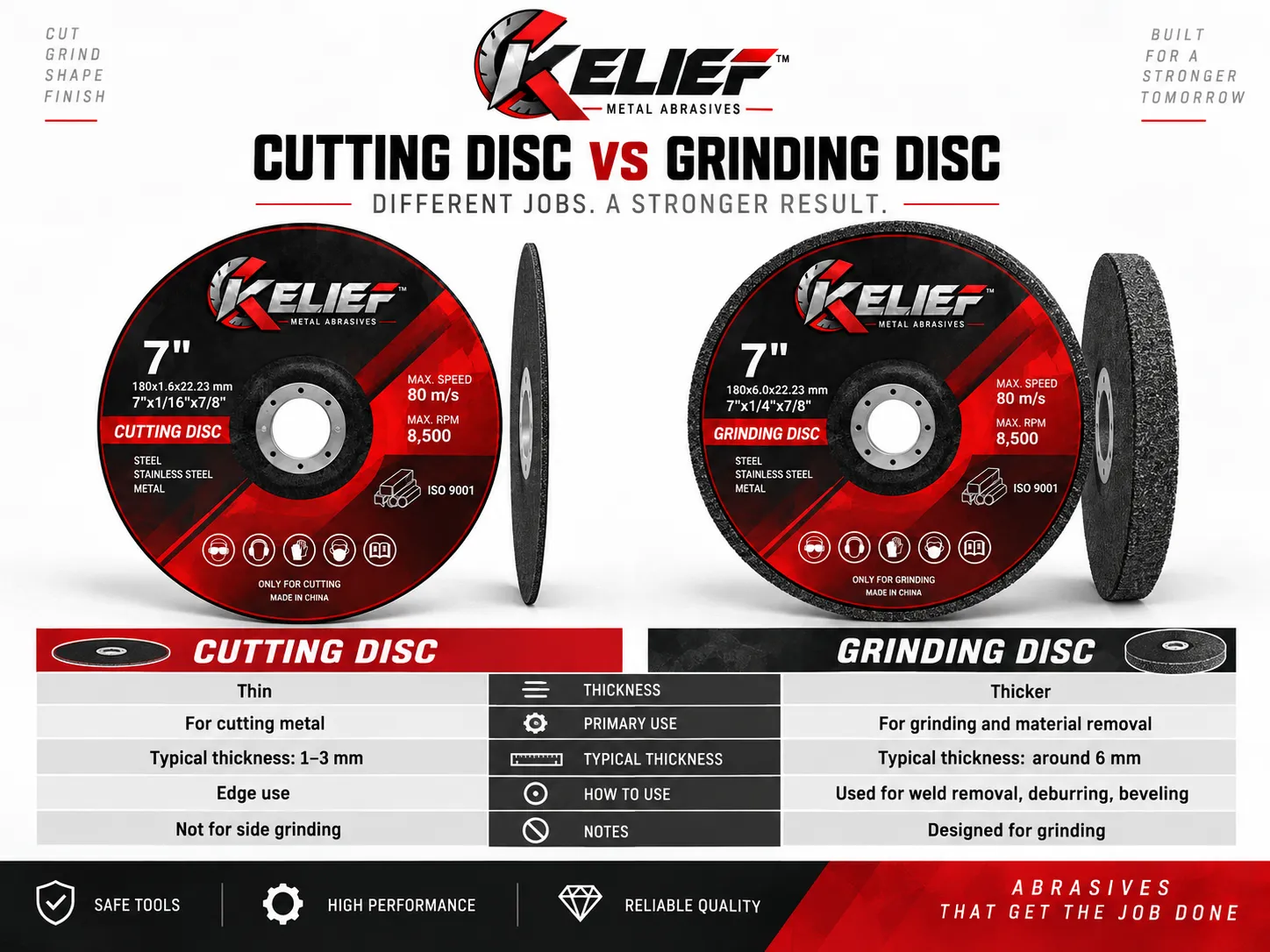
| Feature | Cutting Disc | Grinding Disc |
|---|---|---|
| Main purpose | Cutting through metal | Grinding and material removal |
| Typical construction | Thin | Thick |
| Typical thickness | About 1–3 mm | Around 6 mm is common |
| Working method | Primarily wheel edge | Grinding surface and edge according to wheel design |
| Typical applications | Cutting bar, tube, sheet and profiles | Weld grinding, deburring, beveling and stock removal |
| Side grinding | Generally not intended for side grinding | Designed for grinding applications |
The most important difference is not simply thickness. The wheel construction and intended working direction are different.
Always use an abrasive wheel according to its product marking and the manufacturer’s operating instructions.
Deburring
Deburring means removing sharp edges, burrs, or unwanted projections left after cutting, machining, drilling, or fabrication.
Grinding discs can be used for heavier deburring where relatively high material removal is required.
For lighter finishing operations, other abrasive products may provide a smoother finish.
Depressed Center Wheel
A depressed center wheel has a recessed mounting area around the center of the wheel.
This shape provides clearance between the mounting hardware and the workpiece during grinding.
Type 27 wheels are a common example of depressed-center abrasive wheels.
Diameter
Diameter is the overall outside dimension of an abrasive disc.
Common grinding and cutting disc diameters include:
- 100 mm
- 107 mm
- 115 mm
- 125 mm
- 180 mm
- 230 mm
The correct diameter depends on the machine, application, and wheel specification.
Disc diameter also affects the permitted rotational speed.
Fiberglass Reinforcement
Fiberglass reinforcement is used in many resin-bonded abrasive wheels to increase mechanical strength.
Fiberglass mesh is incorporated into the wheel structure and helps the product withstand forces generated during high-speed rotation and grinding.
The number, position, and construction of reinforcement layers depend on the wheel design.
Fiberglass Mesh
Fiberglass mesh is the woven reinforcement material commonly incorporated into reinforced cutting and grinding wheels.
It works together with the abrasive mixture and bonding system to strengthen the wheel structure.
Finishing
Finishing refers to improving the final condition of a workpiece surface.
Depending on the required finish, this may involve:
- Removing scratches
- Reducing surface roughness
- Blending weld areas
- Preparing metal for coating or painting
A heavy grinding disc is primarily designed for material removal rather than fine polishing.
Glazing
Glazing occurs when the cutting surface of an abrasive wheel becomes relatively smooth because abrasive grains are no longer cutting effectively.
This can reduce grinding efficiency and increase heat.
Wheel specification, workpiece material, machine speed, applied pressure, and operating conditions can all affect glazing behavior.
Grinding Disc
A grinding disc is a bonded abrasive wheel designed for removing material from the surface or edge of a workpiece.
Typical uses include:
- Weld removal
- Deburring
- Edge grinding
- Beveling
- Heavy stock removal
- Surface preparation
A common metal grinding disc may have a thickness of approximately 6 mm, although dimensions vary according to product design.
Grinding Disc Anatomy
A resin-bonded grinding disc is not simply a solid piece of abrasive material.
Its construction normally combines abrasive grains, a bonding system, reinforcement, and product labeling.
Suggested ALT text:grinding disc structure with abrasive grain resin bond fiberglass reinforcement and bore
Understanding these components helps explain why abrasive wheels with similar dimensions may still have different grinding characteristics.
Grinding Efficiency
Grinding efficiency describes how effectively a grinding wheel removes material under specific operating conditions.
It may be influenced by:
- Abrasive grain
- Bond system
- Wheel hardness
- Wheel structure
- Machine power
- Operating speed
- Grinding pressure
- Workpiece material
High grinding speed alone does not necessarily mean that a wheel is the best choice for every application.
Industrial users often consider both material removal and wheel consumption.
Grinding Wheel
A grinding wheel is a general term for a bonded abrasive product used to remove material through abrasive action.
Grinding wheels are available in many shapes, dimensions, abrasive types, and bonding systems.
A grinding disc used on an angle grinder is one form of grinding wheel.
Grit Size
Grit size describes the approximate size of abrasive particles.
In general:
- Lower grit numbers indicate coarser abrasive grains.
- Higher grit numbers indicate finer abrasive grains.
Coarser abrasives are generally associated with more aggressive material removal, while finer abrasives are typically used where a finer surface finish is required.
However, abrasive performance also depends on the grain type, bond, wheel structure, and application.
Heat Generation
Heat generation is the heat produced at the contact area between an abrasive wheel and the workpiece.
Excessive heat may affect:
- Grinding efficiency
- Workpiece surface condition
- Wheel wear
- Discoloration
- Operator control
Heat generation depends on wheel formulation, pressure, machine speed, contact area, and the material being processed.
Loading
Loading occurs when removed workpiece material accumulates in spaces around abrasive grains.
Heavy loading can reduce the wheel’s ability to cut effectively.
The tendency to load varies with material type, wheel specification, and operating conditions.
Material Removal Rate
Material Removal Rate, often abbreviated as MRR, describes the amount of material removed over a given period of time.
It is commonly used when evaluating grinding productivity.
Abrasive performance should not be judged by MRR alone because wheel life, heat generation, surface condition, and operating cost may also matter.
Maximum Operating Speed
Maximum operating speed is the highest peripheral speed at which an abrasive wheel is designed to operate.
It is often displayed in meters per second, such as:
80 m/s
This is different from RPM.
The same maximum peripheral speed corresponds to different RPM limits for different wheel diameters.
Maximum RPM
Maximum RPM is the maximum rotational speed permitted for a particular abrasive wheel.
The machine’s operating speed must not exceed the maximum RPM marked on the wheel.
For example, a larger-diameter wheel operating at the same peripheral speed generally has a lower allowable RPM than a smaller wheel.
Always check the marking on the actual abrasive wheel before use.
OEM
OEM means Original Equipment Manufacturer.
In the abrasive industry, OEM services can include manufacturing cutting and grinding discs according to agreed product requirements and applying the buyer’s own:
- Brand
- Label design
- Packaging
- Product specifications
Requirements depend on order quantity, product type, manufacturing capability, and applicable market requirements.
Peripheral Speed
Peripheral speed is the speed at which the outer edge of a rotating abrasive wheel travels.
It is commonly expressed in:
meters per second (m/s)
Peripheral speed depends on both:
- Wheel diameter
- Rotational speed
This is why RPM limits are not identical for every disc diameter.
PPE
PPE stands for Personal Protective Equipment.
When using abrasive wheels, appropriate PPE may include:
- Eye protection
- Face protection
- Hearing protection
- Gloves
- Suitable respiratory protection
The required PPE depends on the machine, operation, material, and workplace risk assessment.
Always follow local safety requirements and machine instructions.
Private Label
Private label means an abrasive product is manufactured by one company but sold under the buyer’s own brand.
Private-label projects may involve customized:
- Disc labels
- Brand names
- Packaging
- Cartons
- Product specifications
It is commonly used by distributors, wholesalers, importers, and tool brands.
Reinforced Abrasive Wheel
A reinforced abrasive wheel contains reinforcement material intended to increase wheel strength.
Fiberglass mesh is commonly used in resin-bonded cutting and grinding discs.
Reinforcement design varies depending on wheel type, thickness, application, and manufacturing specification.
Resin Bond
A resin bond uses synthetic resin as the principal bonding system for holding abrasive grains together.
Resin-bonded abrasive wheels are widely used for high-speed cutting and grinding applications.
The bond formulation influences:
- Wheel strength
- Grain retention
- Wear behavior
- Grinding action
- Heat response
The bond works together with the abrasive grain and reinforcement system rather than functioning independently.
RPM
RPM stands for revolutions per minute.
It describes how many complete rotations a wheel or machine spindle makes in one minute.
For abrasive wheels, RPM is especially important because the maximum permitted machine speed must never exceed the maximum RPM specified for the wheel.
Related terms: Maximum RPM, Peripheral Speed, Diameter, Maximum Operating Speed.
Sharpness
Sharpness describes the ability of an abrasive wheel to cut or remove material effectively.
A wheel that feels aggressive during grinding may remove material rapidly, but the ideal balance between sharpness and wheel life depends on the application.
Abrasive grain, bond characteristics, formulation, and operating conditions all influence perceived sharpness.
Silicon Carbide
Silicon carbide is a hard and sharp abrasive material used in various grinding and cutting applications.
It is commonly associated with materials such as:
- Stone
- Masonry
- Certain non-ferrous materials
- Other materials depending on wheel formulation
The intended application should always be confirmed from the abrasive wheel specification.
Stock Removal
Stock removal means removing a relatively large amount of material from a workpiece.
Common examples include:
- Removing excess weld metal
- Reducing a metal edge
- Correcting fabricated components
- Preparing a bevel
Thicker grinding discs are commonly used for heavy stock-removal work.
Surface Preparation
Surface preparation refers to preparing a workpiece before the next manufacturing or finishing process.
This may include removing:
- Weld irregularities
- Burrs
- Surface contamination
- Rough edges
- Unwanted material
The appropriate abrasive product depends on how much material needs to be removed and the surface finish required afterward.
T27
T27, or Type 27, refers to a depressed-center abrasive wheel shape.
The recessed center helps provide clearance for the mounting flange and allows the wheel to work at an appropriate grinding angle.
Type 27 is commonly associated with grinding wheels, although the exact intended use must always be confirmed from the wheel marking.
T41
T41, or Type 41, refers to a flat abrasive cut-off wheel shape.
It is widely used for cutting applications where the edge of the disc passes through the workpiece.
Thin Type 41 wheels are commonly used for cutting metal with suitable machines.
Thickness
Thickness is the width of an abrasive disc measured through the body of the wheel.
Thickness is closely related to the intended application.
For example:
- Thin wheels are commonly designed for cutting.
- Thicker wheels are commonly designed for grinding and stock removal.
However, wheel type and product marking should always be checked instead of selecting a wheel by thickness alone.
Wheel Label
The wheel label provides important information about the abrasive product.
A label may show:
- Brand
- Product type
- Dimensions
- Application
- Maximum operating speed
- Maximum RPM
- Safety symbols
- Product identification
Suggested ALT text:abrasive cutting and grinding disc label markings explained
Users should check the wheel label before installation and operation.
Wheel Life
Wheel life describes how long an abrasive wheel remains useful under a particular set of operating conditions.
Wheel life can be influenced by:
- Abrasive formulation
- Workpiece material
- Grinding pressure
- Machine power
- Contact area
- Operator technique
- Grinding angle
- Wheel dimensions
A wheel with a longer life is not automatically the most productive option if its material removal rate is too low for the application.
Wheel Specification
A wheel specification describes the technical characteristics of an abrasive wheel.
Depending on the product and manufacturer, the specification may identify:
- Abrasive type
- Grain size
- Wheel grade
- Bond type
- Wheel dimensions
- Reinforcement
- Application
- Speed limit
Industrial buyers should compare the complete specification rather than relying only on diameter and price.
Weld Grinding
Weld grinding is the process of reducing, shaping, or smoothing weld metal after welding.
Grinding discs are widely used for applications such as:
- Removing excess weld material
- Leveling weld beads
- Preparing welded surfaces
- Correcting fabricated joints
The required grinding aggressiveness depends on the amount of material being removed and the desired final finish.
Weld Removal
Weld removal involves grinding away part or all of a weld so that components can be modified, repaired, separated, or refinished.
Because this process often requires substantial material removal, a grinding disc is commonly selected instead of a thin cutting disc.
Zirconia Alumina
Zirconia alumina is a tough abrasive grain commonly used for demanding metal grinding applications.
It is often selected where aggressive material removal and durability are important.
The actual performance depends on grain quality, bond system, wheel construction, and operating conditions.
How to Read a Grinding or Cutting Disc Specification
One of the most useful skills for buyers and users is understanding the dimensions printed on an abrasive disc.
Consider this example:
180 × 6 × 22.23 mm
| Marking | Meaning |
|---|---|
| 180 mm | Outside disc diameter |
| 6 mm | Disc thickness |
| 22.23 mm | Bore diameter |
| 80 m/s | Maximum operating peripheral speed, when specified |
| RPM | Maximum permitted rotational speed |
| T27 / T41 | Wheel shape or type |
| Steel / Metal | Intended application, depending on product marking |
Dimensions alone are not enough to determine product performance.
Abrasive grain, resin bond, reinforcement, formulation, manufacturing control, and the intended workpiece all affect how a wheel performs.
What Is the Difference Between Cutting and Grinding?
The simplest distinction is:
A cutting disc is designed primarily to separate material, while a grinding disc is designed primarily to remove material from a surface.
A cutting disc is normally thin so that it can pass through metal efficiently.
A grinding disc is normally thicker so that it can withstand the forces associated with grinding, weld removal, deburring, and beveling.
For safety and performance, users should not treat cutting and grinding wheels as interchangeable products.
What Determines Abrasive Wheel Performance?
Abrasive wheel performance is not determined by a single specification.
Several factors work together:
- Abrasive grain determines the cutting characteristics of the abrasive material.
- Bond system controls how grains are retained and released.
- Reinforcement contributes to wheel strength.
- Wheel dimensions influence the application and machine compatibility.
- Formulation influences grinding action, durability, heat generation, and wear.
- Machine conditions affect the actual performance during use.
- Workpiece material changes how the abrasive interacts with the surface.
This is why two abrasive discs with the same size can produce different results in the same application.
Frequently Asked Questions
What are industrial abrasives?
Industrial abrasives are materials and abrasive products used to cut, grind, shape, deburr, finish, or prepare materials in manufacturing and fabrication processes.
They include bonded abrasives, coated abrasives, abrasive grains, grinding wheels, and cutting wheels.
What is a bonded abrasive?
A bonded abrasive consists of abrasive grains held together by a bonding material and formed into a solid product such as a cutting or grinding wheel.
What is a grinding disc used for?
A grinding disc is mainly used for material removal from metal surfaces. Common applications include weld grinding, deburring, beveling, edge grinding, stock removal, and surface preparation.
What is the difference between a cutting disc and a grinding disc?
A cutting disc is thin and designed primarily to cut through material using its edge. A grinding disc is thicker and designed to withstand grinding forces during stock removal, weld grinding, deburring, and beveling.
What does 80 m/s mean on an abrasive disc?
80 m/s indicates a maximum peripheral operating speed of 80 meters per second.
It is not the same as RPM. The corresponding maximum RPM depends on the diameter of the wheel.
What does RPM mean on a grinding wheel?
RPM means revolutions per minute. The maximum RPM printed on a wheel indicates the highest rotational speed at which that specific wheel is intended to operate.
The machine speed must not exceed this limit.
What does T27 mean?
T27, or Type 27, refers to a depressed-center wheel shape commonly used for grinding applications.
What does T41 mean?
T41, or Type 41, refers to a flat cut-off wheel shape commonly used for abrasive cutting.
What does grit size mean?
Grit size describes the approximate size of abrasive particles. In general, lower grit numbers indicate coarser grains and higher numbers indicate finer grains.
What information should a buyer check when selecting abrasive discs?
Industrial buyers should consider more than size and price.
Important factors include:
- Intended material
- Cutting or grinding application
- Disc dimensions
- Bore size
- Maximum RPM
- Operating speed
- Abrasive formulation
- Grinding performance
- Wheel life
- Batch consistency
- Packaging requirements
- OEM or private-label requirements
Choosing Abrasive Discs for Industrial and Wholesale Use
For distributors, importers, wholesalers, and industrial users, abrasive disc selection should consider both product performance and supply consistency.
A useful evaluation process includes:
Application → Material → Wheel Type → Dimensions → Speed Rating → Performance → Supply Consistency
For example, a buyer sourcing metal grinding discs may need to compare not only dimensions such as 115 × 6 × 22.23 mm or 180 × 6 × 22.23 mm, but also grinding speed, durability, heat generation, batch consistency, packaging, and private-label requirements.
KELIEF focuses on resin-bonded metal cutting discs and grinding discs for professional and industrial applications, with OEM and private-label options available for B2B customers.
When evaluating a product, the objective should be to match the abrasive wheel to the real application rather than selecting a wheel from dimensions alone.
Related Resources
To learn more about abrasive cutting and grinding, explore:
- What Is a Grinding Disc Used For?
- Cutting Disc vs Grinding Disc
- How to Choose the Right Grinding Disc
- What Does 80 m/s Mean on an Abrasive Wheel?
- T27 vs T41 Abrasive Wheels
Understanding these terms makes it easier to compare abrasive products, read technical specifications, communicate with manufacturers, and choose the right wheel for a specific metalworking application.
