


How Does a Grinding Disc Work?
Grinding is essentially a controlled cutting process performed by many abrasive particles at the same time.
Each exposed abrasive grain acts like a very small cutting edge. As the rotating disc contacts the workpiece:
- Abrasive grains contact the surface.
- The grains penetrate and remove small chips of material.
- Cutting edges gradually wear or fracture.
- New abrasive edges are exposed as the wheel wears.
- The bonded wheel maintains its shape while material is removed.
Grinding performance therefore depends on the relationship between the abrasive, bond, wheel structure, workpiece and operating conditions.
Applying excessive pressure does not automatically increase productivity. Too much pressure may increase heat, accelerate wheel wear, overload the grinder or negatively affect the workpiece.
The objective is to use a wheel specifically matched to the material and operation while allowing the abrasive to perform its intended cutting action.
What Is a Grinding Disc Made Of?
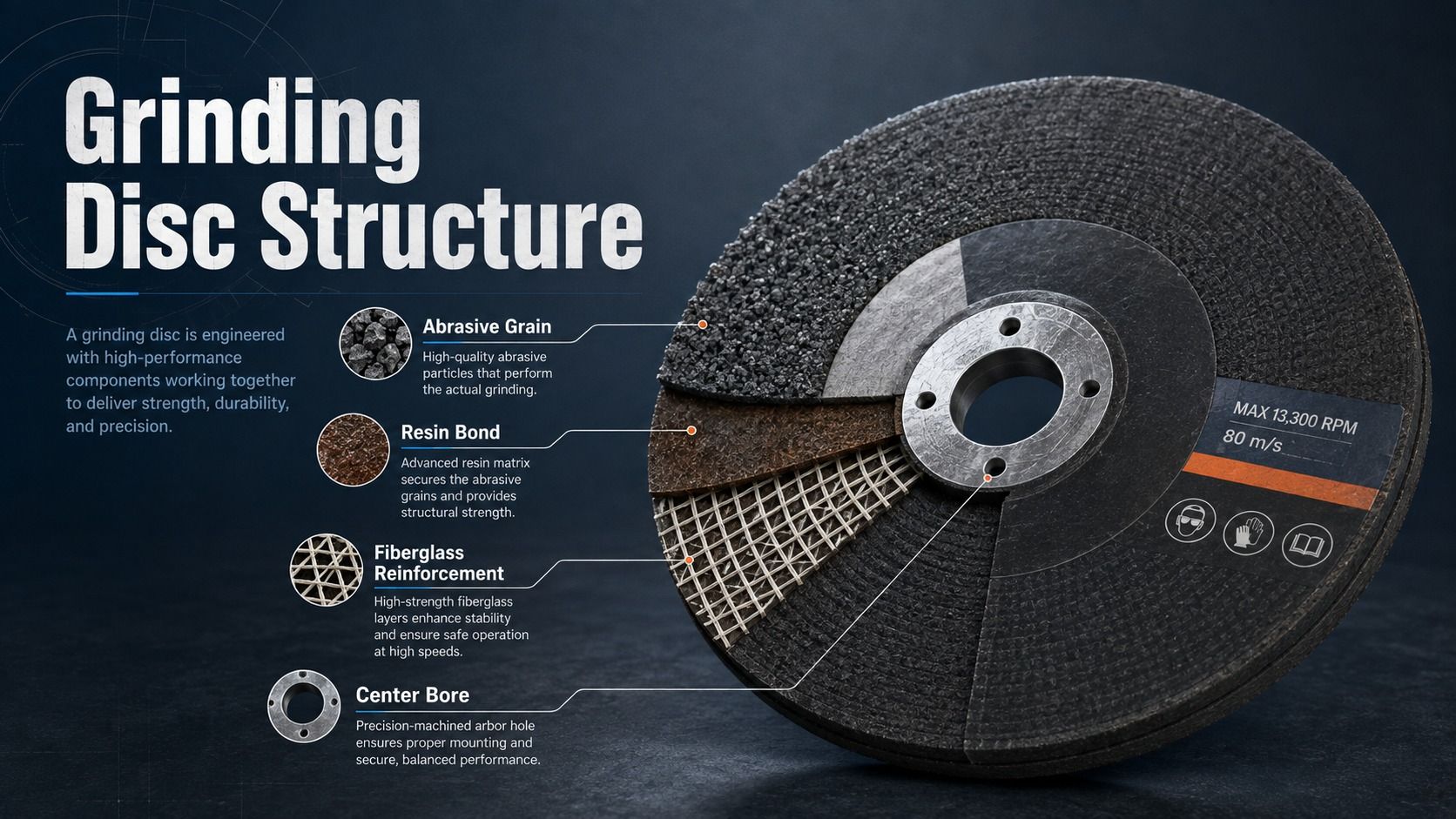
A resin-bonded grinding disc used on an angle grinder typically combines several functional components.
Abrasive Grain
The abrasive grain performs the actual material removal.
Common abrasive families include:
- Aluminum oxide
- Zirconia alumina
- Ceramic alumina
- Silicon carbide
Different grains have different toughness, fracture behavior, cutting characteristics and suitability for different materials.
Resin Bond
The bond holds the abrasive grains together and helps control how the wheel behaves during grinding.
Portable metal grinding wheels commonly use an organic resin-based bonding system because it can provide the combination of strength and grinding characteristics required for high-speed applications.
The exact bond formulation should be matched to the wheel design and intended grinding application.
Fiberglass Reinforcement
Fiber-reinforced grinding discs incorporate fiberglass mesh within the wheel structure.
The reinforcement supports the bonded abrasive body during operation and is an important structural element in wheels designed for portable grinding equipment.
KELIEF T27 wheels use a fiber-reinforced resin-bonded construction designed for compatible guarded angle grinders.
Center Bore and Ring
The center bore allows the wheel to be mounted on compatible equipment.
Depending on the product design, the center area can incorporate a metal ring or other mounting structure.
Diameter alone is therefore not enough when selecting a wheel. Bore size must also match the intended machine configuration.
Main Types of Grinding Discs
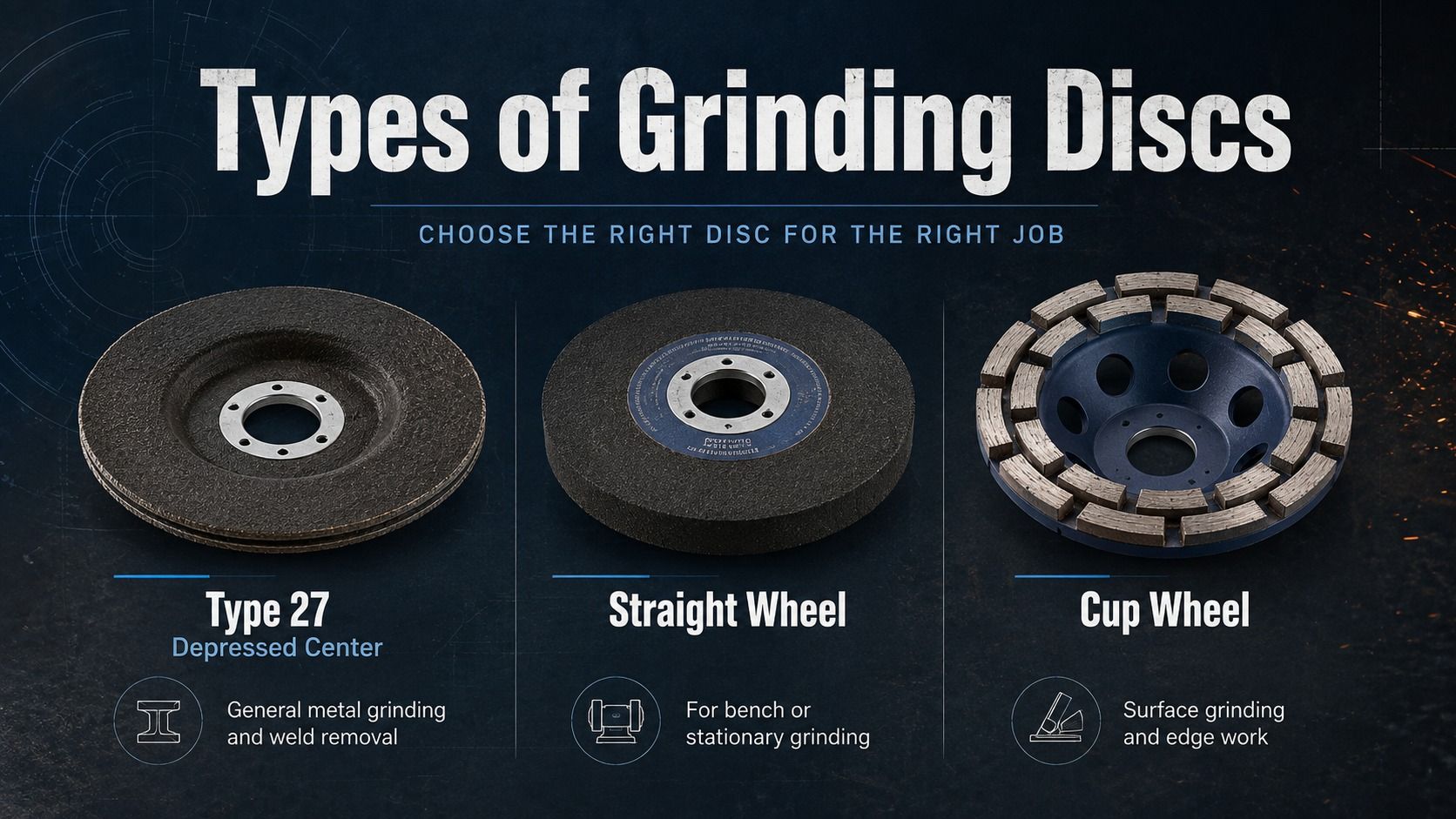
Grinding wheels are manufactured in many shapes because different machines and contact geometries require different designs.
For general metalworking, three configurations are useful to understand.
Type 27 Depressed-Center Grinding Disc
The Type 27, or T27, depressed-center grinding wheel is one of the most common configurations for portable angle grinders.
Its center area is recessed relative to the grinding surface, creating clearance between the grinder mounting assembly and the workpiece.
T27 wheels are widely used for:
- Weld grinding
- Surface grinding
- Edge beveling
- Burr removal
- Slag removal
- General metal stock removal
KELIEF’s grinding wheel range is centered on this type of wheel, with sizes from compact 100mm products through larger 230mm configurations.
For example, the 125mm T27 Grinding Wheel uses a 125 × 6 × 22mm configuration for compatible 125mm angle grinders.
Straight Grinding Wheel
A straight grinding wheel has a comparatively simple flat wheel profile.
Straight wheels are widely used in bench grinders, stationary grinders and industrial grinding equipment.
Their construction, abrasive specification and operating requirements can differ substantially from portable T27 angle-grinder wheels.
Cup Grinding Wheel
Cup-shaped wheels provide a different contact geometry and are used for particular surface, edge and specialized grinding operations.
Because cup wheels may be used with different equipment and guarding arrangements, they should not be treated as interchangeable with a T27 wheel simply because both products are used for grinding.
Grinding Disc vs Cutting Disc vs Flap Disc
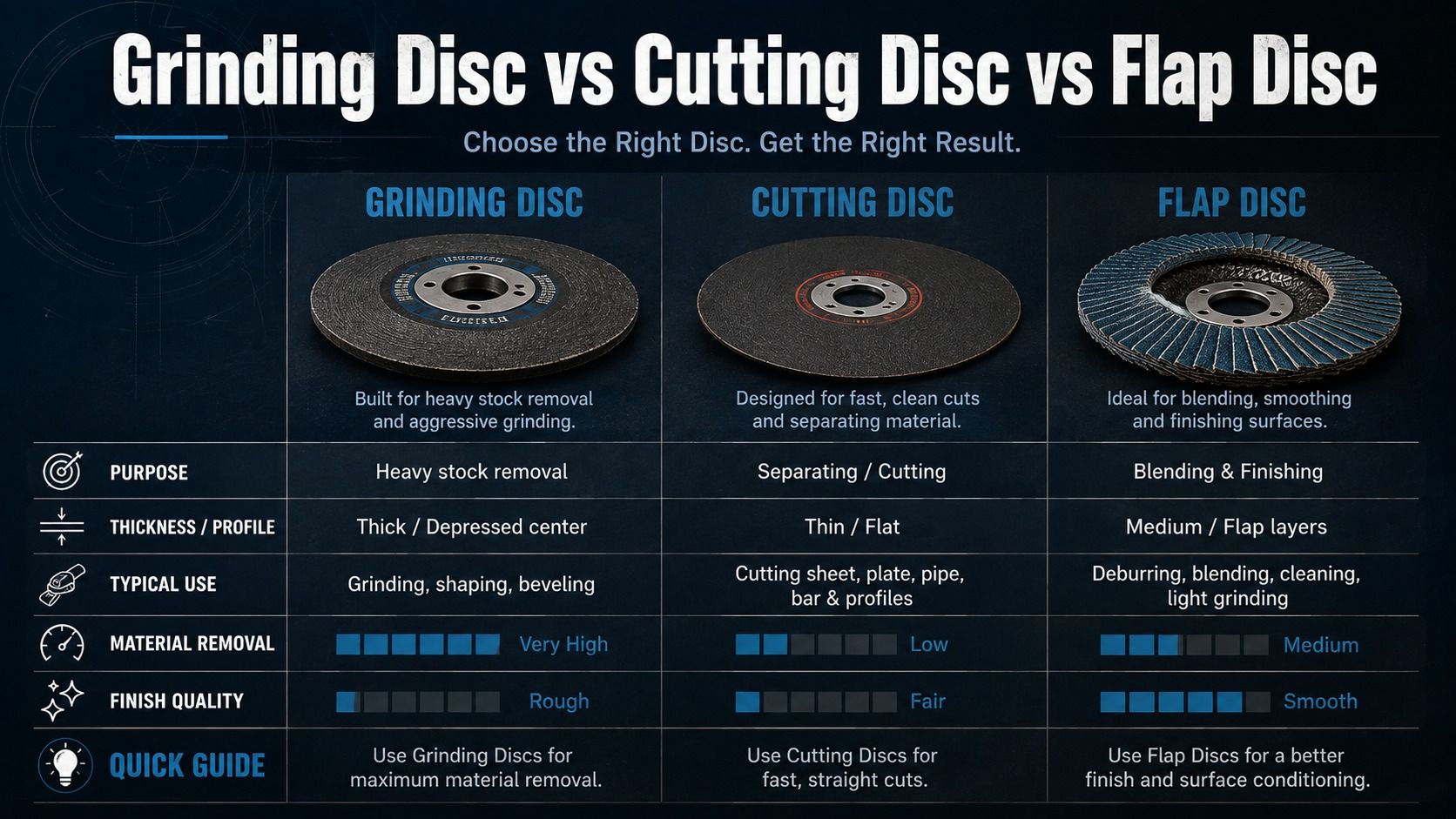
Grinding discs, cutting discs and flap discs may all fit angle grinders, but they are designed for different jobs.
| Feature | Grinding Disc | Cutting Disc | Flap Disc |
|---|---|---|---|
| Main purpose | Stock removal and grinding | Separating material | Grinding, blending and finishing |
| Typical profile | Relatively thick | Thin | Layered abrasive flaps |
| Typical action | Grinding with wheel face/working area | Cutting through an edge | Abrasive grinding with flexible flaps |
| Material removal | High | Focused on the cut | Moderate, depending on grit |
| Surface finish | Usually rougher | Not primarily a finishing tool | Generally better suited to blending |
| Common applications | Weld removal, beveling, surface grinding | Pipe, bar, plate and profile cutting | Weld blending, deburring, finishing |
When to Use a Grinding Disc
Choose a grinding disc when the main objective is to remove a meaningful amount of material.
Examples include:
- Grinding a raised weld
- Beveling a steel edge
- Removing large burrs
- Correcting an uneven fabricated surface
When to Use a Cutting Disc
A cutting disc is intended primarily to separate material rather than grind the face of a workpiece.
Use cutting wheels for applications such as cutting:
- Steel pipe
- Rebar
- Sheet
- Plate
- Bar
- Structural profiles
A thin cutting wheel should not be treated as a substitute for a thick grinding wheel.
When to Use a Flap Disc
A flap disc combines abrasive-coated flaps around a backing plate.
It is particularly useful when the job requires a balance between material removal and surface blending.
For example, after an aggressive grinding disc removes a large weld, a flap disc may be used for further blending depending on the required surface condition.
Grinding Disc Abrasive Materials Explained
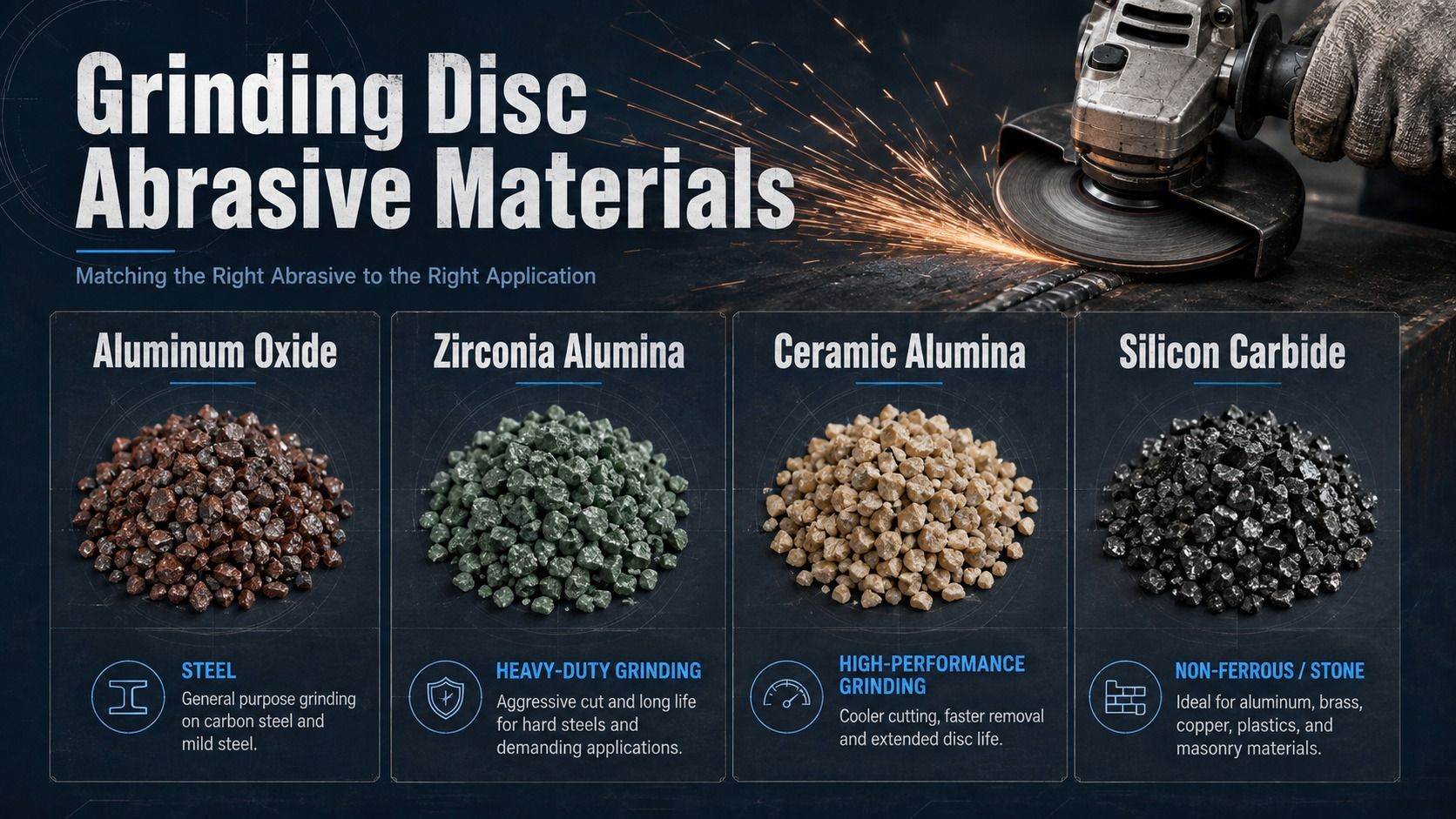
The abrasive grain strongly influences how a grinding wheel interacts with the workpiece.
However, grain type should never be considered in isolation. Wheel bond, hardness, grit, structure, operating pressure and application all affect the final result.
Aluminum Oxide Grinding Discs
Aluminum oxide is one of the most widely used conventional abrasives for grinding ferrous metals.
It is commonly associated with applications involving:
- Carbon steel
- Mild steel
- Structural steel
- General metal fabrication
Its widespread use makes aluminum oxide an important choice for general-purpose metal grinding.
For many distributors, a general metal grinding wheel based around an appropriate aluminum oxide formulation can form the foundation of a standard product range.
Zirconia Alumina Grinding Discs
Zirconia alumina is commonly used where more aggressive grinding and higher stock removal are required.
It is known for good performance under demanding grinding pressure and is widely used in heavy-duty metal applications.
Potential applications include:
- Heavy weld removal
- Structural steel grinding
- Fabrication
- High-pressure stock removal
- Certain stainless steel applications when the wheel is specifically formulated for that material
The formulation of the complete wheel still matters. Do not assume that every zirconia product is automatically suitable for every steel or stainless steel application.
Ceramic Alumina Grinding Discs
Ceramic alumina is used in high-performance abrasive products where cutting efficiency, life and productivity are important.
Ceramic abrasive structures can continuously expose sharp cutting points as they fracture under suitable grinding conditions.
They are often considered for:
- Difficult-to-grind metals
- Higher productivity requirements
- Demanding industrial grinding
- Applications where heat generation must be carefully controlled
Higher-performance abrasive grain does not automatically mean it is the correct solution for every operation. Machine power, applied pressure and workpiece characteristics must also suit the wheel.
Silicon Carbide Grinding Discs
Silicon carbide is a hard, sharp abrasive commonly associated with lower-tensile materials, non-ferrous metals and various non-metallic materials.
Applications can include certain:
- Aluminum components
- Cast materials
- Non-ferrous metals
- Stone or masonry materials
- Specialized grinding operations
Always use a wheel specifically designed and marked for the intended material.
Understanding Grinding Disc Grit
Grit size describes the approximate size of abrasive particles in the wheel.
As a general rule:
- Coarser grit favors faster stock removal.
- Finer grit favors a finer surface result.
This does not mean grit alone determines performance.
A complete grinding wheel specification also includes factors such as:
- Abrasive type
- Grain characteristics
- Wheel hardness or grade
- Bond
- Reinforcement
- Wheel geometry
- Workpiece material
- Contact area
- Machine speed and power
Coarse Grit
Coarse grinding specifications are commonly used when the main goal is aggressive removal rather than a fine surface finish.
Typical tasks include:
- Weld removal
- Heavy deburring
- Edge preparation
- Rapid stock removal
Finer Grit
Finer abrasive specifications become more relevant as surface quality becomes more important.
For portable metalworking, this may also be the point where another abrasive product—such as a flap disc—becomes more appropriate than a thick bonded grinding wheel.
The practical question is therefore not simply:
What grit should I use?
A better question is:
What wheel specification gives the required removal rate and finish on this material with this machine?
Grinding Disc Sizes: 100mm, 115mm, 125mm, 150mm, 180mm and 230mm
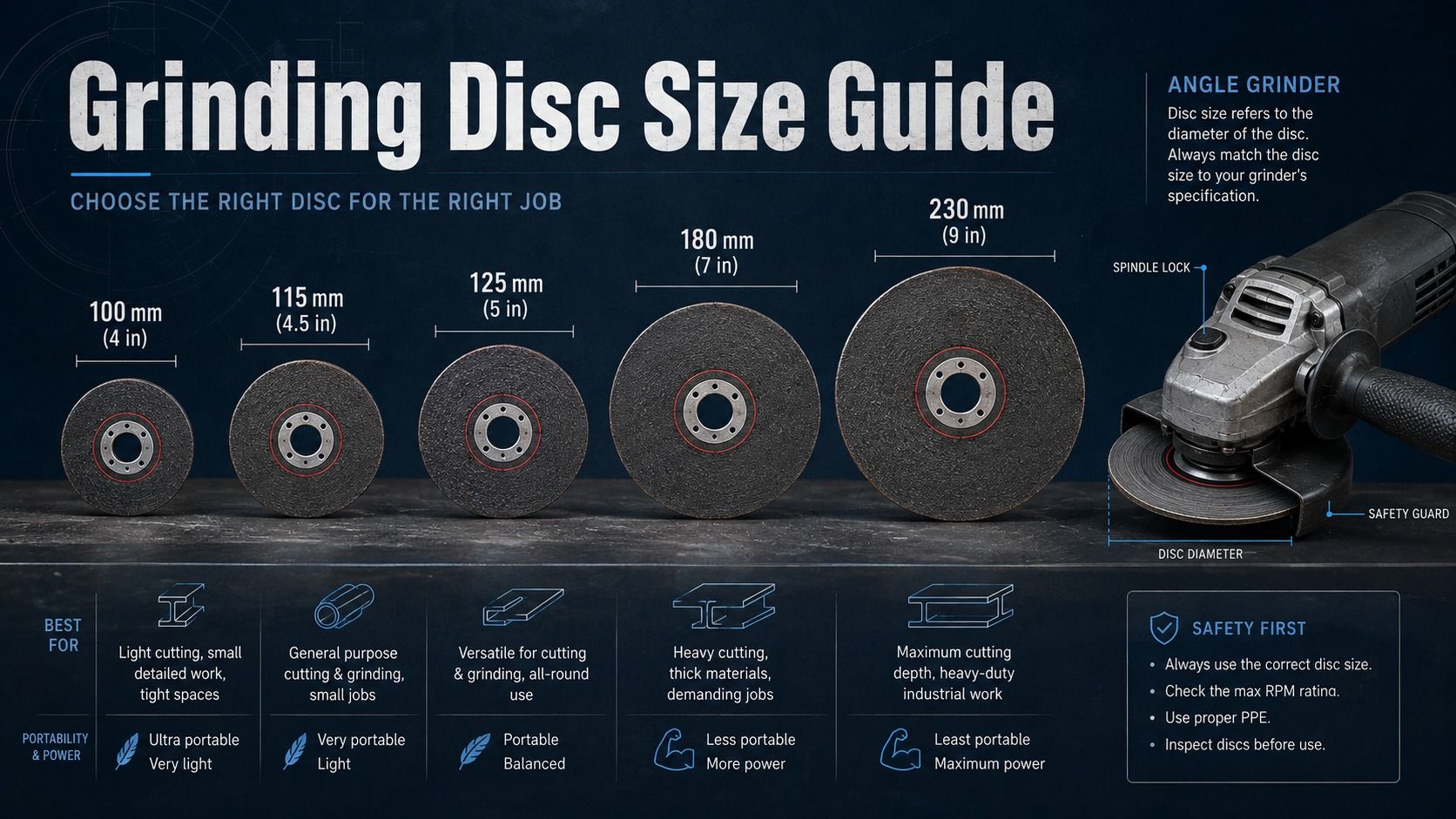
Grinding disc diameter must match compatible grinding equipment.
Common portable grinding wheel diameters include:
| Diameter | Approx. Inch Size | Typical Positioning |
|---|---|---|
| 100mm | 4 in | Compact portable grinding |
| 115mm | 4.5 in | Light and general fabrication |
| 125mm | 5 in | General-purpose portable grinding |
| 150mm | 6 in | Intermediate grinding applications |
| 180mm | 7 in | Larger fabrication and stock removal |
| 230mm | 9 in | Heavy-duty portable metal grinding |
Diameter should never be selected independently from the grinder specification.
You must also confirm:
- Wheel thickness
- Bore size
- Wheel type
- Maximum wheel speed
- Grinder spindle configuration
- Guard compatibility
- Intended application
KELIEF currently supplies T27 grinding wheel configurations across these common size ranges.
Representative products include:
For wholesale sourcing, browse the complete KELIEF Grinding Wheels category.
How to Read a Grinding Disc Specification
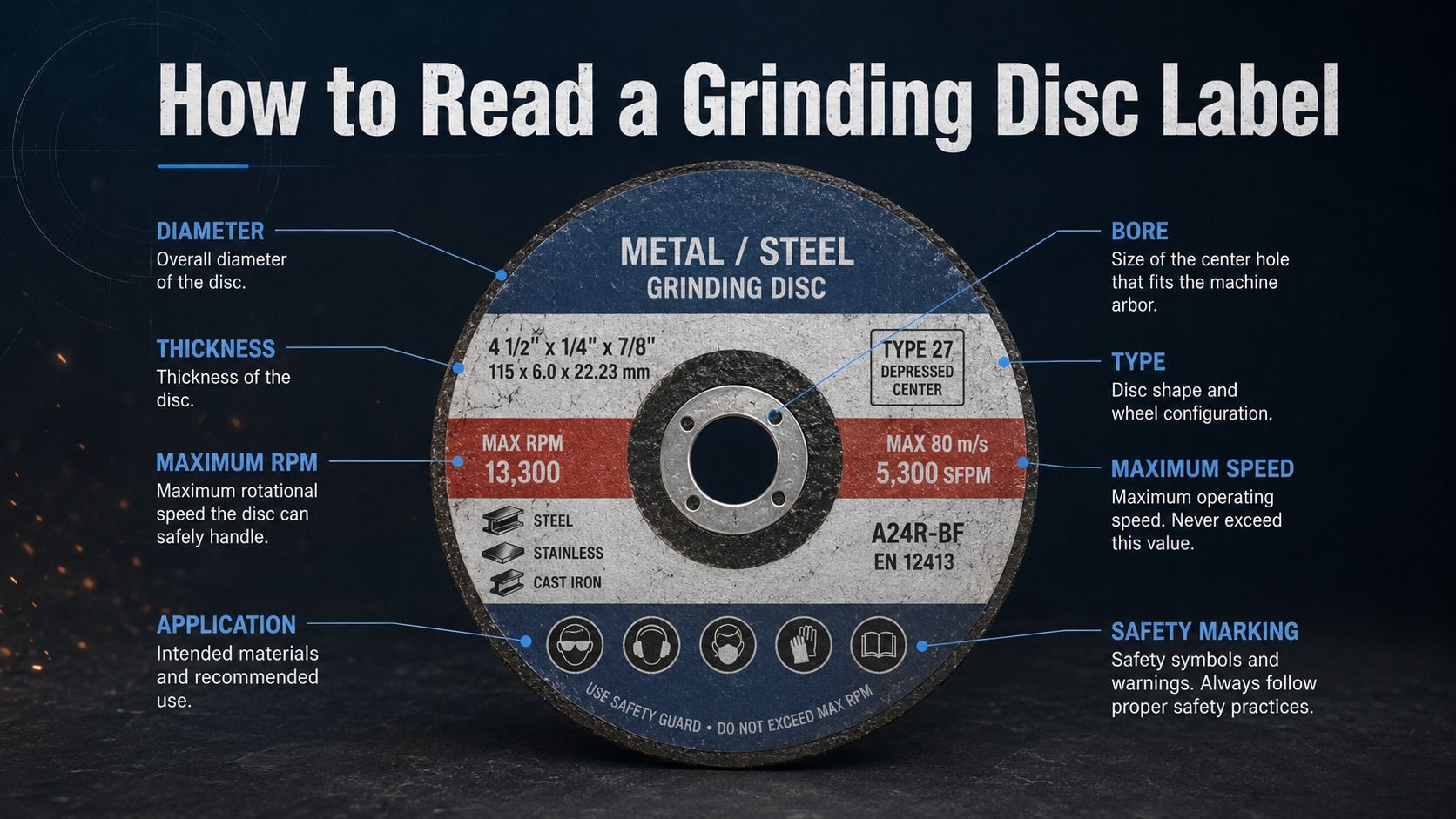
A grinding wheel label communicates important information about the product and its intended operating conditions.
The exact marking format differs between manufacturers and markets, but several fields are especially important.
Diameter × Thickness × Bore
A specification such as:
125 × 6 × 22 mm
normally indicates:
- 125mm outside diameter
- 6mm wheel thickness
- 22mm center bore
These dimensions must be checked against the machine.
Wheel Type
A marking such as T27 identifies the wheel shape or configuration.
For portable metal grinding, a depressed-center T27 design provides clearance for the mounting area while allowing the wheel to contact the workpiece at a practical grinding angle.
Abrasive Specification
Grinding wheel markings may include codes relating to:
- Abrasive family
- Grit
- Grade or hardness
- Bond system
- Manufacturer-specific formulation
Marking systems are not necessarily identical between manufacturers, so the wheel manufacturer’s product data should be used when interpreting a specific code.
Maximum RPM
The maximum RPM shown on a grinding wheel is a critical safety value.
The grinder must not operate the wheel above the maximum speed permitted for that wheel.
Never assume two wheels of similar diameter have identical operating limits.
Maximum Operating Speed
Some wheels also display maximum peripheral operating speed, commonly expressed in meters per second.
This value relates wheel diameter to safe rotational speed and must not be exceeded.
Application Marking
The wheel may indicate the intended workpiece or use, such as:
- Steel
- Stainless steel
- Metal
- Stone
Only use the wheel for applications permitted by its actual manufacturer markings and technical information.
Safety Markings
Common wheel labels can also include pictograms relating to:
- Eye protection
- Hearing protection
- Protective gloves
- Respiratory protection
- Reading operating instructions
- Use of a grinder guard
Always treat the actual wheel label and manufacturer instructions as authoritative.
How to Choose the Right Grinding Disc
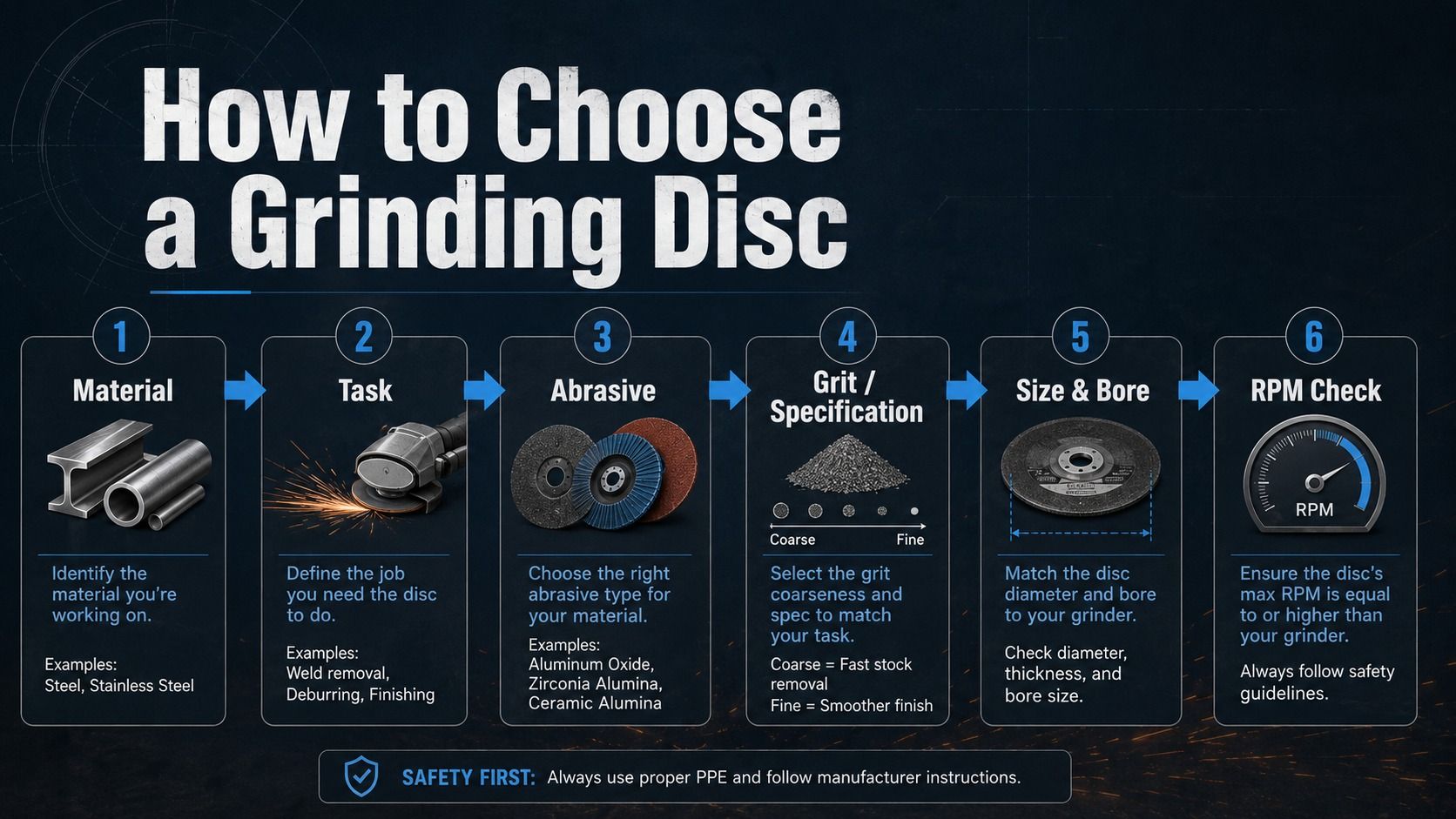
A practical grinding disc selection process can be reduced to six steps.
Step 1: Identify the Workpiece Material
Start with the material.
Is it:
- Carbon steel?
- Mild steel?
- Stainless steel?
- Cast iron?
- Aluminum?
- Another alloy or non-metal?
Material affects abrasive selection, wheel formulation, heat generation and grinding behavior.
Step 2: Define the Grinding Task
Next identify what you actually want the wheel to do.
For example:
- Remove a heavy weld
- Grind welding slag
- Bevel an edge
- Deburr a fabricated part
- Level a surface
- Prepare a surface
- Remove a defect
A wheel intended for aggressive weld grinding does not need the same performance balance as one used for lighter surface work.
Step 3: Select the Abrasive System
Match the abrasive family and wheel formulation to the workpiece and grinding severity.
General starting points include:
- Aluminum oxide for many steel applications
- Zirconia alumina for demanding stock removal
- Ceramic alumina for higher-performance grinding
- Silicon carbide for selected non-ferrous and non-metal applications
These are starting principles, not universal product prescriptions.
Step 4: Choose the Appropriate Wheel Specification
Consider:
- Grit
- Wheel hardness
- Bond
- Reinforcement
- Thickness
- Removal rate
- Desired surface result
For OEM programs, these parameters can be adjusted together rather than treating them as isolated choices.
Step 5: Match Diameter and Bore to the Grinder
Check:
- Outside diameter
- Center bore
- Thickness
- Wheel shape
- Spindle and flange system
- Grinder guard
Never force a wheel onto a spindle.
Step 6: Verify Speed Compatibility
Check the maximum permitted wheel speed before installation.
The grinder’s operating speed must be compatible with the wheel’s marked operating limit.
This check should be part of every grinding wheel selection and installation process.
Grinding Disc Selection by Material
Best Grinding Disc for Mild Steel
Mild and carbon steels are among the most common materials processed with bonded grinding wheels.
For general fabrication, an appropriate aluminum oxide wheel is a common starting point.
Typical jobs include:
- Weld removal
- Surface leveling
- Beveling
- Burr removal
- Fabricated steel repair
For more demanding removal rates, zirconia or higher-performance formulations may be evaluated.
The final wheel should still be selected according to actual grinding pressure, machine power, desired wheel life and surface requirements.
Grinding Disc for Stainless Steel
Stainless steel requires more careful product selection.
Use a grinding wheel that is specifically designed and identified by the manufacturer for stainless steel or the intended stainless application.
Important considerations include:
- Heat generation
- Required removal rate
- Surface condition
- Abrasive formulation
- Contamination requirements
- Wheel life
Do not assume that a general-purpose carbon-steel grinding wheel should automatically be used on stainless steel.
For commercial sourcing or private-label programs, the intended stainless grade and application should be communicated to the abrasive supplier before the final wheel configuration is selected.
Grinding Disc for Cast Iron
Cast materials may behave differently from ductile steel during grinding.
Depending on the exact cast material and application, aluminum oxide or silicon carbide based products may be considered.
Because “cast iron” covers different compositions and hardness levels, selection should be based on the actual workpiece rather than the material name alone.
Grinding Disc for Aluminum
Aluminum can load the working surface of unsuitable abrasive products because it is relatively soft and ductile.
Use a wheel specifically specified for aluminum or the intended non-ferrous application.
Do not select a wheel for aluminum simply because it physically fits the grinder.
Grinding Disc Selection by Application
Weld Grinding
Weld removal normally requires relatively high stock removal.
A thick T27 grinding wheel can be an effective choice for removing raised weld material, slag and excess metal.
A common workflow can be:
- Use a grinding wheel for major stock removal.
- Stop when the weld approaches the desired profile.
- Switch to a more suitable blending or finishing abrasive if a smoother result is required.
The KELIEF 125mm T27 Grinding Wheel is designed around common weld removal, edge and surface grinding applications.
Edge Beveling
Beveling prepares an edge for fabrication, welding or another process.
The wheel should provide:
- Stable stock removal
- Suitable access to the edge
- Compatible wheel thickness
- Appropriate grinder control
T27 depressed-center geometry is commonly used for this type of portable metalworking.
Deburring
Heavy burrs may require a grinding wheel, while lighter burrs may be better handled with a flap disc or another finishing abrasive.
Choosing the most aggressive possible abrasive is not always the most efficient approach.
The goal should be to remove the burr without unnecessary damage to the surrounding surface.
Surface Preparation
Grinding wheels can remove:
- High spots
- Weld residue
- Slag
- Local defects
- Excess metal
For applications where only rust, paint or light surface contamination needs to be removed, another abrasive product may be more suitable than a thick grinding disc.
Heavy Stock Removal
When productivity is the main objective, consider the complete grinding system:
- Abrasive grain
- Wheel hardness
- Bond
- Wheel thickness
- Grinder power
- Contact area
- Grinding pressure
- Workpiece material
This is where application-specific wheel matching can produce more meaningful performance improvements than simply changing grit size.
How to Use a Grinding Disc Safely
Grinding wheels operate at high rotational speeds and must be treated as engineered safety-critical products.
Always follow the wheel manufacturer’s instructions and the safety requirements applicable in your country and workplace.
Important basic checks include:
Inspect the Wheel Before Use
Do not install a wheel that shows signs of:
- Cracking
- Impact damage
- Deformation
- Water or chemical damage
- Damaged bore
- Missing or unreadable markings
Use the Correct Grinder Guard
Do not remove the guard simply to reach the workpiece more easily.
Use a machine and guard configuration designed for the selected abrasive wheel.
Check the Wheel and Machine Speed
The machine must not operate the wheel above its marked maximum speed.
Check the wheel every time you change:
- Diameter
- Product family
- Grinder
- Wheel specification
Check Mounting Compatibility
The grinding wheel should fit the machine correctly.
Do not:
- Force the wheel onto the spindle
- Use improvised mounting hardware
- Use damaged flanges
- Over-tighten the mounting assembly
Wear Appropriate PPE
Grinding can generate:
- Sparks
- Abrasive fragments
- Metal particles
- Dust
- Noise
Appropriate PPE may include eye and face protection, gloves, hearing protection, protective clothing and respiratory protection where required by the operation and workplace risk assessment.
For U.S. workplaces, OSHA provides requirements covering abrasive-wheel guarding, wheel inspection, mounting and grinder/wheel speed compatibility. See the OSHA abrasive wheels and tools standard.
Common Grinding Disc Problems and What They May Indicate
Grinding problems are often caused by a combination of wheel selection, machine condition and operating technique.
| Problem | Possible Factors to Check |
|---|---|
| Disc wears too quickly | Wheel specification too soft for the application, excessive pressure, unsuitable abrasive, severe contact conditions |
| Grinding is too slow | Abrasive too dull, wheel too hard, insufficient machine power, unsuitable wheel specification |
| Excessive heat | Excessive pressure, unsuitable abrasive, glazed wheel surface, insufficient cutting action |
| Workpiece discoloration | Excessive localized heat or unsuitable grinding conditions |
| Excessive vibration | Wheel damage, incorrect mounting, worn machine components, imbalance |
| Wheel loading | Workpiece material clogging the wheel surface or unsuitable wheel specification |
| Rough finish | Grit/specification too aggressive for required finish or excessive grinding pressure |
| Poor wheel life | Incorrect wheel/application match, unsuitable operating technique or excessive load |
If wheel behavior changes unexpectedly, stop and identify the reason instead of compensating by applying more pressure.
How to Store Grinding Discs
Proper storage protects wheels before they reach the grinder.
Grinding discs should generally be kept:
- Dry
- Protected from impact
- Away from excessive heat
- Away from aggressive chemicals
- In suitable original or protective packaging
- In a location that prevents bending or deformation
Inventory should also be managed so products can be identified by batch, specification and product marking.
Do not assign a universal shelf life to every abrasive wheel.
Storage requirements and usable life depend on the product, bond system, manufacturer requirements and applicable standards. Follow the product manufacturer’s instructions and date markings where provided.
Choosing Grinding Discs for Industrial and Wholesale Supply
For a single operator, the main question may be:
Which wheel works for this job?
For an importer, distributor or private-label tool brand, the question is broader:
Which grinding wheel range should we build for our market?
A commercial grinding wheel program should consider more than diameter.
Build the Range Around Real Applications
Start with common customer requirements such as:
- Carbon steel fabrication
- Stainless steel processing
- Weld removal
- General maintenance
- Structural steel
- Hardware retail
- Industrial supply
Then define the wheel configurations required for those applications.
Standardize Core Sizes
Common angle-grinder diameters such as 100mm, 115mm, 125mm, 150mm, 180mm and 230mm can form the foundation of a product family.
But the exact portfolio should reflect the grinder sizes used in the target country.
Confirm Wheel Specifications
For every SKU, define:
- Diameter
- Thickness
- Bore
- Wheel type
- Abrasive formulation
- Grit
- Hardness
- Reinforcement
- Target material
- Intended application
This reduces ambiguity when comparing products or placing repeat orders.
Consider OEM and Private-Label Requirements
Abrasive products are often sold as part of a distributor or hardware brand rather than under the factory’s own label.
KELIEF supports custom abrasive wheel and private-label programs covering options such as:
- Diameter
- Thickness
- Bore size
- Abrasive formula
- Grit
- Wheel hardness
- Fiberglass reinforcement
- Wheel color
- Product labels
- Inner boxes
- Export cartons
- Barcodes and shipping marks
For qualified customization projects, sample evaluation can also be completed before the final bulk configuration is confirmed.
This is particularly useful when the buyer needs to evaluate grinding behavior rather than comparing specifications only on paper.
Frequently Asked Questions
What is a grinding disc used for?
A grinding disc is used to remove material from a workpiece. Common metalworking applications include weld removal, edge beveling, deburring, surface leveling, slag removal and general stock removal.
What is the difference between a grinding disc and a cutting disc?
A grinding disc is designed primarily for material removal through grinding, while a cutting disc is designed to separate material through a narrow cut. Cutting discs are generally thinner and should not be used as substitutes for thick grinding wheels.
What is the difference between a grinding disc and a flap disc?
A bonded grinding disc is generally better suited to aggressive stock removal. A flap disc uses overlapping coated-abrasive flaps and is often preferred when blending and surface finish are more important.
Which grinding disc is best for steel?
For many general steel applications, aluminum oxide is a common abrasive starting point. More demanding stock removal may use zirconia or ceramic formulations. The best wheel still depends on the exact steel, grinding task, machine and required performance.
What grinding disc should I use for stainless steel?
Use a grinding disc specifically designed and marked for stainless steel or the intended stainless application. Consider abrasive formulation, grinding temperature, contamination requirements, removal rate and finish.
What grit grinding disc should I use?
Coarser abrasive specifications generally favor faster stock removal, while finer specifications favor a finer surface result. Select grit together with abrasive type, wheel hardness, bond and the required finish rather than choosing by grit alone.
Can I use a grinding disc for cutting?
Do not use a grinding wheel as a cutting wheel unless the product manufacturer specifically states that the wheel is designed for that operation. Use a product designed and marked for the intended cutting or grinding task.
How do I choose the right grinding disc size?
Match the disc diameter, thickness, bore and wheel type to the grinder manufacturer’s requirements. Then verify that the wheel’s maximum operating speed is compatible with the machine.
Can I use a 125mm grinding disc on any angle grinder?
No. The grinder must be designed for that wheel diameter and must also be compatible with the wheel bore, mounting system, guard and maximum operating speed.
What does RPM mean on a grinding disc?
RPM means revolutions per minute. The maximum RPM marked on the wheel indicates the maximum rotational speed permitted for that product. Never operate a wheel above its marked limit.

